
Overview
Starting at the spectacular cliffs of Slieve League, the trail runs from the west Donegal in the Republic of Ireland and passes the wide-open spaces of the Sperrins, rugged Causeway Coast and across the magnificent Glens of Antrim to Larne, Co. Antrim in Northern Ireland.
Spanning 279 miles, the route takes walkers through some wonderfully diverse landscapes the trail can be walked as a through walk, completed in stages or enjoyed as part of a day hike.
History
The Appalachian Trail (AT) runs over 3,000 miles from Georgia in the south of the United States of America to its northern terminus on Mount Katahdin in Maine, stopping short of the Canadian border. In 1994 the idea to continue a trail along the remnants of the Appalachian-Caledonian Mountains across the political border into Canada was proposed and the International Appalachian Trail (IAT) was born.
By 2009 consideration was being given to extending the IAT. Greenland became the first chapter outside of North America followed closely by Scotland. There are now IAT Chapters in Maine, New Brunswick, Quebec, Nova Scotia, Prince Edward Island, Newfoundland & Labrador, Greenland, Iceland, Ireland, Scotland, England, Isle of Man, Wales, Norway, Spain, Portugal, and Morocco.
The Ulster-Ireland Chapter of the International Appalachian Trail was officially launched in 2013 and measures approximately 279 miles/449km running from the west Donegal in the Republic of Ireland to Larne, Co. Antrim in Northern Ireland.
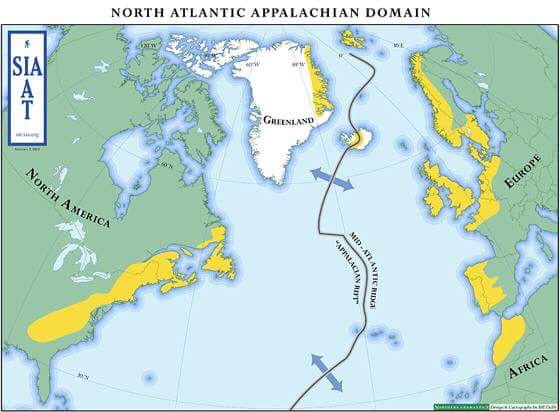
The Appalachian Mountains – 250 million years ago and today
Partners
The IAT Ulster-Ireland crosses five council areas in Northern Ireland including Fermanagh and Omagh, Derry and Strabane, Causeway Coast and Glens, Mid Ulster and Mid and East Antrim as well as Donegal.
The development needs of the route are serviced through the activities of a steering group which includes the local councils which the route traverses, Donegal Local Development Company, the Republic of Ireland’s Dept. of Foreign Affairs, National Trust, Causeway Coast and Glens Heritage Trust, Tourism Ireland, Tourism Northern Ireland, Fáilte Ireland, the Ulster Federation of Rambling Clubs, the Northern Ireland Environment Agency, Geological Survey Ireland, Geological Survey of Northern Ireland and the Ulster American Folk Park.
There is also a working group which includes representatives from the partner Local Action Groups (LAGs) in each council area and Donegal who have come together to scope, develop and deliver a rural cooperation project through the Rural Development Programme 2014-2020 which has included the development of this website.
Signage
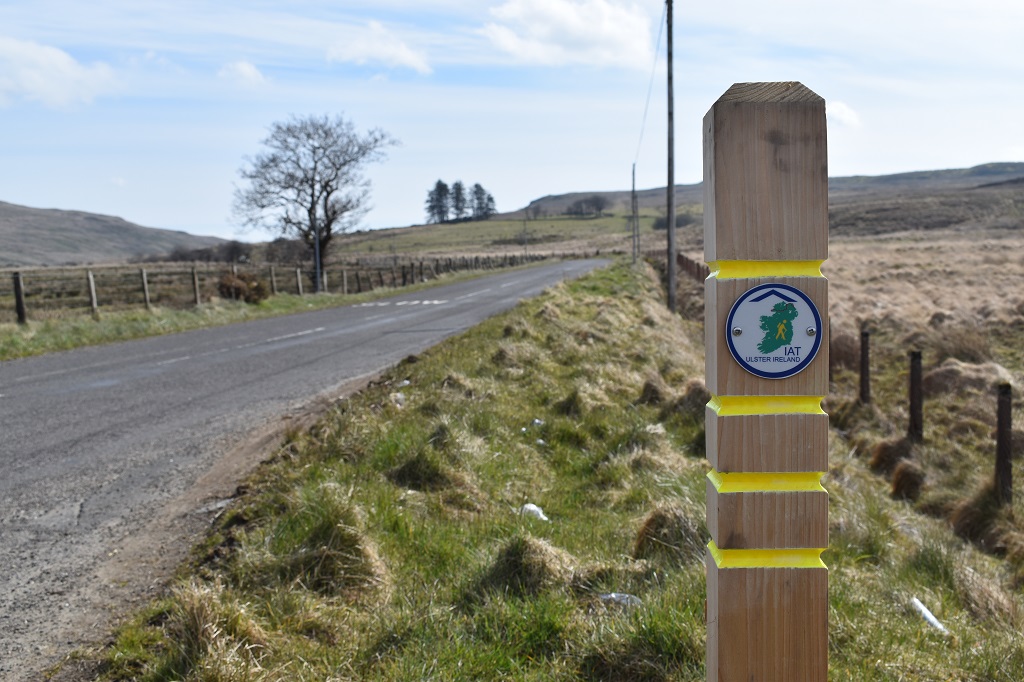
The signage for the International Appalachian Trail is the same in each country featuring a yellow walker and map of Ireland.
Accessibility
The IAT Ulster-Ireland route takes in a wide range of terrains including steep cliff paths, forest tracks, open mountain and glens and quiet country roads. Those looking to explore the trail with limited mobility should check the accessible grades (see an overview of the grades below) given in the walk descriptions on our Suggested Itineraries page are suitable before visiting. Please note the full route is challenging and we recommend that only those with a good level of fitness and who have confidence and experience in outdoor environments where the weather can change dramatically should take on the full route.
-
Grade 1
- The path can be expected to be hard and firm with no loose material and will be over 2m wide for its entire length, or over 1.5m wide with adequate passing places.
- The path will not be steeper than 3° or have a cross slope of greater than 3°.
- There will not be any obstacles such as steps, stiles or surface breaks and there will be a clear head height of greater than 2.10m in width and height for the entire length of the route.
- There will be passing places at least every 50m and rest areas at least every 100m.
- Grade 2
- Grade 3
- Grade 4
- Grade 5